Workflow automation that decides
Rule-based automation breaks the moment your process changes. GRID is the layer underneath — it reads what is happening, decides what to run, and leaves a trace you can check.
Rule-based automation breaks
Most automation tools give you rigid if/then rules. When your process changes — and it always does — the automation breaks, and you spend more time maintaining it than it ever saved. The tool never understood the work; it only followed the wiring.
GRID is the layer underneath
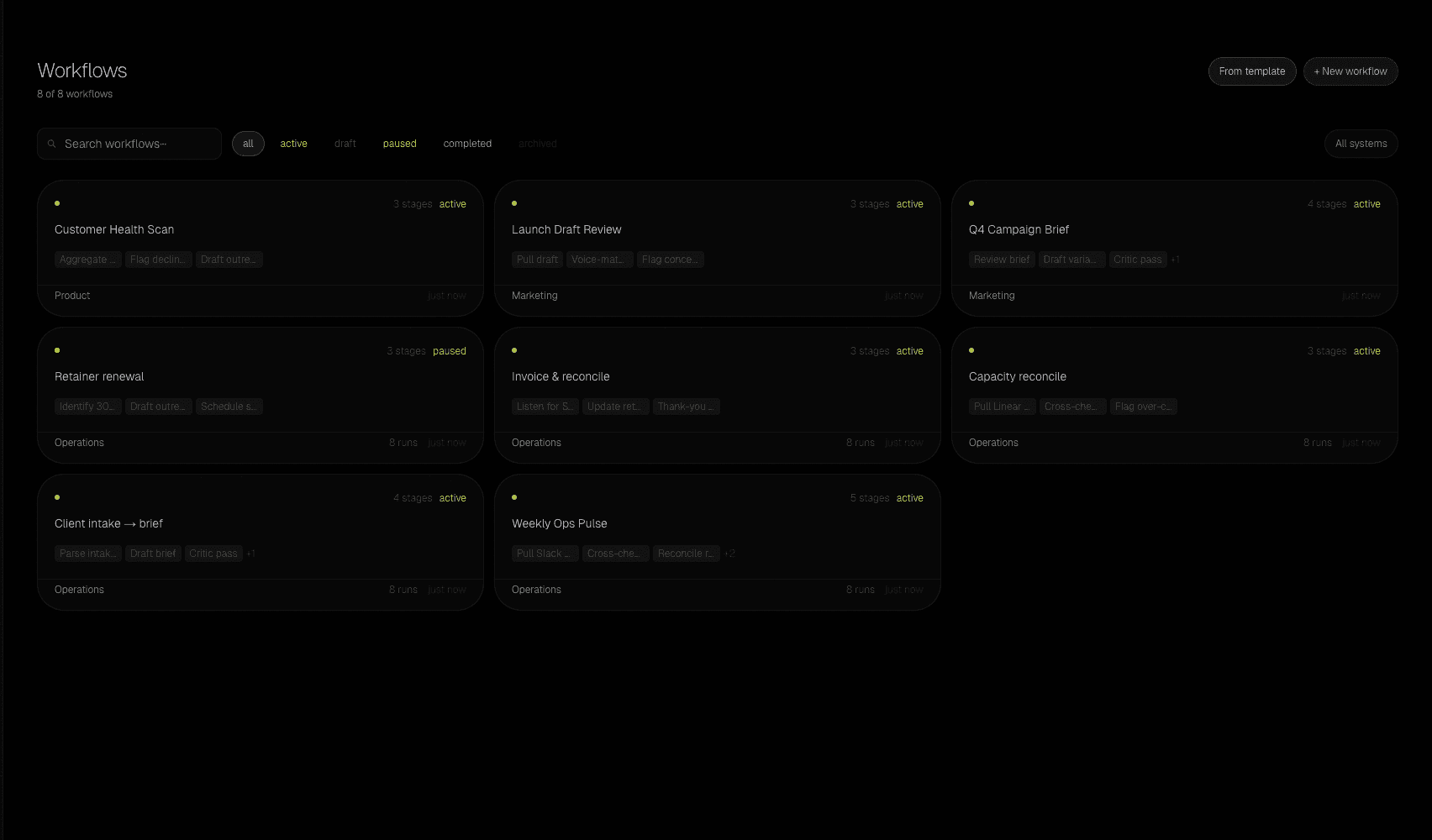
GRID is not another automation tool. It is the substrate your tools run on. A Workflow in GRID is how a System expresses itself: you describe what it is for, and GRID runs it — reading the inputs, deciding what each step needs, acting. When a step consistently causes friction, GRID surfaces it as a Signal.
You describe it. You do not draw it.
There is no canvas of boxes and arrows to maintain. You say what the Workflow is for; GRID composes the run. Every action it takes is visible as a trace — what it read, what it decided, what it skipped — so the work stays legible instead of becoming a black box.
Built for operators, not automation engineers
You do not need a workflows specialist. GRID is for the operator who is currently the connective tissue of the business — routing between tools by hand. The point is not to save a few clicks. It is to move the operating system out of your head and into a substrate that runs it.